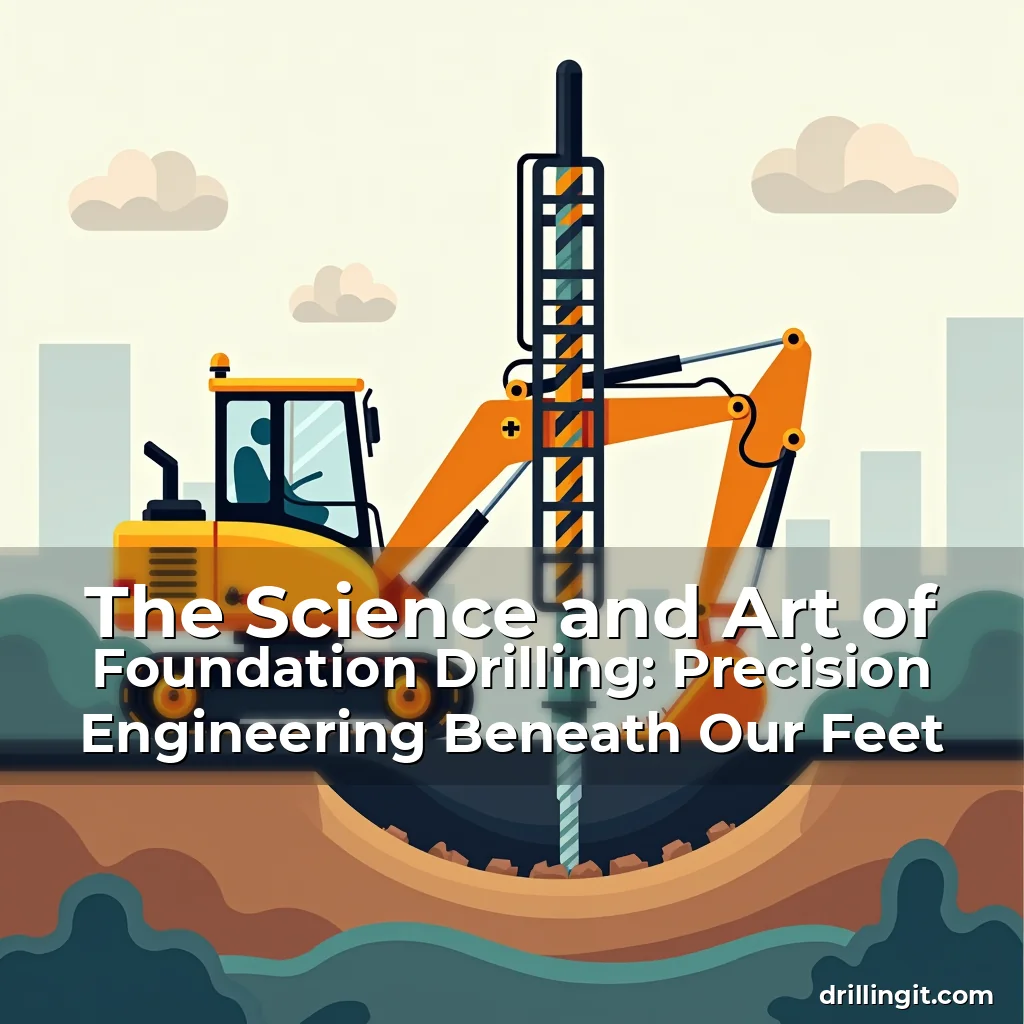
The Science and Art of Foundation Drilling: Precision Engineering Beneath Our Feet
In an era where construction projects grow increasingly complex, foundation drilling stands as the unsung hero beneath every skyscraper, bridge, and residential home. This specialized technique ensures structural integrity by anchoring buildings deep within the earth’s crust.
Fundamentally, foundation drilling is the process of creating boreholes to install piles that transfer building loads to stable soil layers or bedrock. It combines geotechnical engineering principles with mechanical innovation to achieve remarkable results.
The Evolution of Foundation Drilling Techniques
From ancient civilizations using simple augers to modern machines capable of drilling thousands of feet underground, the evolution of foundation drilling reflects humanity’s quest for stability in construction.
The Industrial Revolution marked a turning point with the invention of rotary drill rigs. These early machines laid the groundwork for today’s advanced drilling systems used in megastructures worldwide.
Contemporary technologies now incorporate GPS guidance, real-time monitoring sensors, and automated control systems. Such innovations ensure precision down to millimeter accuracy during critical infrastructure projects.
Specialized methods have emerged to address unique challenges, including underwater drilling for offshore platforms and micro-piling techniques for historic preservation work.
- Cable boring: A non-invasive method used for installing utility lines without disrupting existing structures
- Percussion drilling: Ideal for hard rock formations due to its hammering action through impact force
- Rotary drilling: The most common technique utilizing rotating bits to cut through various geological materials
- Auger drilling: Effective for softer soils using helical screw mechanisms to extract material efficiently
Geotechnical Investigations Before Drilling Begins
Before any drilling operation commences, extensive site investigations are conducted to determine subsurface conditions. Geologists analyze soil composition and groundwater levels to inform drilling strategies.
Borehole logging provides crucial data about soil stratification patterns. Engineers use this information to predict load-bearing capacities at different depths across the project area.
Seismic surveys help identify potential fault lines or unstable ground features that could compromise foundation stability. This proactive approach prevents costly mid-project surprises.
Hydrogeological assessments map out water table fluctuations, ensuring proper drainage solutions are incorporated into the foundation design.
Case Study: The Burj Khalifa Project
Dubai’s iconic Burj Khalifa required over 192 reinforced concrete piles drilled to depths exceeding 50 meters. Soil samples from hundreds of test borings informed these precise specifications.
Engineers discovered varying strata compositions ranging from soft clay to dense sandstone layers. Customized pile designs accommodated these differences while maintaining structural harmony.
The entire foundation system had to withstand both vertical compressive forces and lateral wind-induced movements characteristic of high-rise architecture.
This meticulous preparation exemplifies how thorough pre-drilling analysis contributes to architectural marvels standing tall against nature’s elements.
Types of Foundation Piles Used in Modern Construction
Driven piles rely on percussion energy to penetrate soil layers until reaching competent bearing strata. They’re commonly used in areas with loose granular deposits.
Bored piles involve excavating cylindrical voids before filling them with reinforced concrete. This method allows greater flexibility in adapting to changing ground conditions.
Screw piles utilize helical blades to anchor themselves into the substrate. Their installation causes minimal disturbance compared to other pile types.
Sheet piles form continuous walls that provide support for excavation pits or serve as retaining structures along waterfront developments.
Advanced Technologies Transforming Foundation Drilling
Modern drilling rigs integrate digital twins – virtual replicas of physical equipment – enabling predictive maintenance and performance optimization. These models simulate real-world operating conditions accurately.
Automation has revolutionized repetitive tasks such as bit rotation speed adjustments and pressure regulation. Computer-controlled systems maintain consistent quality standards throughout operations.
Remote sensing capabilities allow operators to monitor subterranean progress in real time via video feeds and sensor arrays embedded in drill strings.
Artificial intelligence algorithms now assist in interpreting geophysical data faster than human analysts ever could, accelerating decision-making processes significantly.
Safety Protocols in Foundation Drilling Operations
Rigorous safety procedures govern every stage of foundation drilling activities. Personnel must undergo regular training sessions covering emergency response protocols and hazard recognition.
Vibration dampening systems protect nearby structures from potential damage caused by heavy machinery vibrations during pile driving operations.
Continuous air quality monitoring ensures safe working environments free from harmful dust particles generated during excavation phases.
Emergency shutdown mechanisms are strategically placed around all active drilling sites for immediate access during unforeseen situations.
Economic Implications of Foundation Drilling Decisions
Strategic choices made during initial planning stages profoundly affect long-term financial outcomes. Inadequate foundation solutions can lead to catastrophic failures requiring complete reconstruction efforts later.
Investments in high-quality drilling equipment often pay dividends through increased efficiency rates and reduced downtime requirements during construction cycles.
Properly engineered foundations contribute to lower maintenance costs throughout a structure’s lifespan by preventing settlement issues and structural fatigue.
Environmental considerations also influence economic factors; sustainable practices may qualify developers for tax incentives or regulatory exemptions.
Sustainability Considerations in Contemporary Drilling Practices
Green initiatives now shape modern foundation drilling approaches aimed at minimizing ecological footprints. Recyclable materials are preferred whenever possible without compromising structural integrity.
Water conservation measures become essential when dealing with aquifers near drilling locations. Advanced filtration systems prevent contamination risks associated with hydraulic fluids.
Electric-powered drilling units reduce carbon emissions compared to traditional diesel engines, aligning with global climate change mitigation goals.
Soil stabilization techniques involving bioengineering solutions promote natural regeneration rather than relying solely on chemical treatments.
The Future of Foundation Drilling Innovation
Ongoing research explores novel materials that could enhance pile durability under extreme loading scenarios. Self-healing concretes containing microcapsules offer promising applications for future construction needs.
Nanotechnology advancements might enable development of ultra-strong composite materials suitable for deep-sea platform foundations subjected to immense hydrostatic pressures.
Autonomous robotic drilling systems represent another frontier being actively investigated for remote or hazardous site implementations where human presence would be impractical.
Integration of blockchain technology promises improved transparency regarding supply chain management for critical components used in foundation systems worldwide.
Conclusion
Foundation drilling remains a cornerstone discipline in civil engineering, evolving continuously alongside technological progress and environmental awareness.
By embracing innovative methodologies while prioritizing sustainability objectives, professionals ensure resilient infrastructural networks capable of meeting tomorrow’s demands responsibly.
“`
The Science and Art of Foundation Drilling: Precision Engineering Beneath Our Feet
In an era where construction projects grow increasingly complex, foundation drilling stands as the unsung hero beneath every skyscraper, bridge, and residential home. This specialized technique ensures structural integrity by anchoring buildings deep within the earth’s crust.
Fundamentally, foundation drilling is the process of creating boreholes to install piles that transfer building loads to stable soil layers or bedrock. It combines geotechnical engineering principles with mechanical innovation to achieve remarkable results.
The Evolution of Foundation Drilling Techniques
From ancient civilizations using simple augers to modern machines capable of drilling thousands of feet underground, the evolution of foundation drilling reflects humanity’s quest for stability in construction.
The Industrial Revolution marked a turning point with the invention of rotary drill rigs. These early machines laid the groundwork for today’s advanced drilling systems used in megastructures worldwide.
Contemporary technologies now incorporate GPS guidance, real-time monitoring sensors, and automated control systems. Such innovations ensure precision down to millimeter accuracy during critical infrastructure projects.
Specialized methods have emerged to address unique challenges, including underwater drilling for offshore platforms and micro-piling techniques for historic preservation work.
- Cable boring: A non-invasive method used for installing utility lines without disrupting existing structures
- Percussion drilling: Ideal for hard rock formations due to its hammering action through impact force
- Rotary drilling: The most common technique utilizing rotating bits to cut through various geological materials
- Auger drilling: Effective for softer soils using helical screw mechanisms to extract material efficiently
Geotechnical Investigations Before Drilling Begins
Before any drilling operation commences, extensive site investigations are conducted to determine subsurface conditions. Geologists analyze soil composition and groundwater levels to inform drilling strategies.
Borehole logging provides crucial data about soil stratification patterns. Engineers use this information to predict load-bearing capacities at different depths across the project area.
Seismic surveys help identify potential fault lines or unstable ground features that could compromise foundation stability. This proactive approach prevents costly mid-project surprises.
Hydrogeological assessments map out water table fluctuations, ensuring proper drainage solutions are incorporated into the foundation design.
Case Study: The Burj Khalifa Project
Dubai’s iconic Burj Khalifa required over 192 reinforced concrete piles drilled to depths exceeding 50 meters. Soil samples from hundreds of test borings informed these precise specifications.
Engineers discovered varying strata compositions ranging from soft clay to dense sandstone layers. Customized pile designs accommodated these differences while maintaining structural harmony.
The entire foundation system had to withstand both vertical compressive forces and lateral wind-induced movements characteristic of high-rise architecture.
This meticulous preparation exemplifies how thorough pre-drilling analysis contributes to architectural marvels standing tall against nature’s elements.
Types of Foundation Piles Used in Modern Construction
Driven piles rely on percussion energy to penetrate soil layers until reaching competent bearing strata. They’re commonly used in areas with loose granular deposits.
Bored piles involve excavating cylindrical voids before filling them with reinforced concrete. This method allows greater flexibility in adapting to changing ground conditions.
Screw piles utilize helical blades to anchor themselves into the substrate. Their installation causes minimal disturbance compared to other pile types.
Sheet piles form continuous walls that provide support for excavation pits or serve as retaining structures along waterfront developments.
Advanced Technologies Transforming Foundation Drilling
Modern drilling rigs integrate digital twins – virtual replicas of physical equipment – enabling predictive maintenance and performance optimization. These models simulate real-world operating conditions accurately.
Automation has revolutionized repetitive tasks such as bit rotation speed adjustments and pressure regulation. Computer-controlled systems maintain consistent quality standards throughout operations.
Remote sensing capabilities allow operators to monitor subterranean progress in real time via video feeds and sensor arrays embedded in drill strings.
Artificial intelligence algorithms now assist in interpreting geophysical data faster than human analysts ever could, accelerating decision-making processes significantly.
Safety Protocols in Foundation Drilling Operations
Rigorous safety procedures govern every stage of foundation drilling activities. Personnel must undergo regular training sessions covering emergency response protocols and hazard recognition.
Vibration dampening systems protect nearby structures from potential damage caused by heavy machinery vibrations during pile driving operations.
Continuous air quality monitoring ensures safe working environments free from harmful dust particles generated during excavation phases.
Emergency shutdown mechanisms are strategically placed around all active drilling sites for immediate access during unforeseen situations.
Economic Implications of Foundation Drilling Decisions
Strategic choices made during initial planning stages profoundly affect long-term financial outcomes. Inadequate foundation solutions can lead to catastrophic failures requiring complete reconstruction efforts later.
Investments in high-quality drilling equipment often pay dividends through increased efficiency rates and reduced downtime requirements during construction cycles.
Properly engineered foundations contribute to lower maintenance costs throughout a structure’s lifespan by preventing settlement issues and structural fatigue.
Environmental considerations also influence economic factors; sustainable practices may qualify developers for tax incentives or regulatory exemptions.
Sustainability Considerations in Contemporary Drilling Practices
Green initiatives now shape modern foundation drilling approaches aimed at minimizing ecological footprints. Recyclable materials are preferred whenever possible without compromising structural integrity.
Water conservation measures become essential when dealing with aquifers near drilling locations. Advanced filtration systems prevent contamination risks associated with hydraulic fluids.
Electric-powered drilling units reduce carbon emissions compared to traditional diesel engines, aligning with global climate change mitigation goals.
Soil stabilization techniques involving bioengineering solutions promote natural regeneration rather than relying solely on chemical treatments.
The Future of Foundation Drilling Innovation
Ongoing research explores novel materials that could enhance pile durability under extreme loading scenarios. Self-healing concretes containing microcapsules offer promising applications for future construction needs.
Nanotechnology advancements might enable development of ultra-strong composite materials suitable for deep-sea platform foundations subjected to immense hydrostatic pressures.
Autonomous robotic drilling systems represent another frontier being actively investigated for remote or hazardous site implementations where human presence would be impractical.
Integration of blockchain technology promises improved transparency regarding supply chain management for critical components used in foundation systems worldwide.
Conclusion
Foundation drilling remains a cornerstone discipline in civil engineering, evolving continuously alongside technological progress and environmental awareness.
By embracing innovative methodologies while prioritizing sustainability objectives, professionals ensure resilient infrastructural networks capable of meeting tomorrow’s demands responsibly.
“`